In Brief
Malawi illustrates a critical extension of the presource curse concept: the trigger is not always a single giant discovery. In a country with low resource-sector maturity, a portfolio of anticipated mining investments can generate identical dynamics — elevated growth expectations, premature borrowing pressure, governance strain, and the risk of growth disappointments. The mechanisms are the same; only the trigger differs.
Horizon Risk: Growth Trajectory
Malawi is tracked as a Horizon Risk country. The chart below shows actual total GDP against the IMF WEO vintage forecast from the relevant anchor year. Both series are indexed using a single WEO source — eliminating cross-source measurement noise.
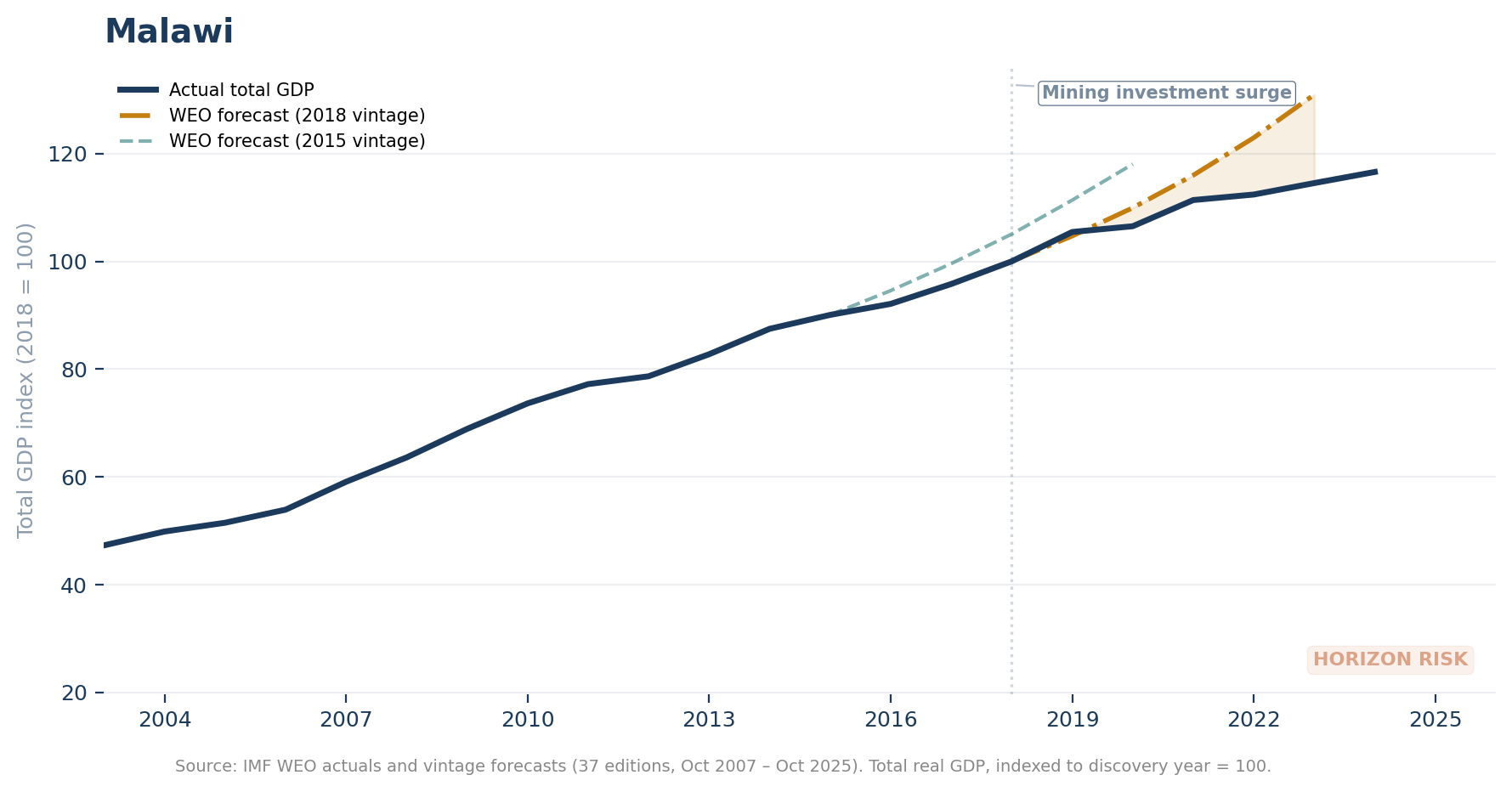
Source: IMF WEO actuals and vintage forecasts. See the Horizon Risk Explorer for all twelve monitored countries.
Lessons and Policy Implications
The trigger is anticipated wealth, not a single discovery
A portfolio of anticipated investments in a low-capacity state can activate the same presource mechanisms as a Jubilee-scale event. The presource curse is not limited to petroleum giants.
Overborrowing against mining expectations
Malawi is already classified as in external debt distress, with public debt at 88% of GDP. If capital markets extend credit against projected mining revenues before those revenues materialise, debt dynamics could deteriorate further and rapidly.
Growth forecasts that are already too optimistic
The government projects mining contributing 12% of GDP by 2027 from less than 1% today. Achieving a twelve-fold increase in three years would require simultaneous on-time delivery of multiple complex projects — an implausible scenario.
This case matters for critical minerals investment across Africa
The minerals in question — rutile, graphite, niobium, rare earths — are central to the global energy transition. The Malawi case is directly relevant to the new wave of critical mineral investment across sub-Saharan Africa.
References
- IMF (2025). Malawi: 2025 Article IV Consultation. IMF Country Report No. 25/226.
- Malawi Ministry of Finance (2025). Annual Economic Report 2025.
- Mihalyi, D. and Scurfield, T. (2021). 'How Did Africa's Prospective Petroleum Producers Fall Victim to the Presource Curse?' Extractive Industries and Society, 8(1).
- World Bank (2025). Malawi Economic Monitor, 21st Edition.
James Cust · Development Economics · jamescust.com