The Framework
Growth Threats Taxonomy
Seven core threats and six compounding vulnerabilities — the identifiable patterns that derail growth in countries that might otherwise sustain it.
The Lab's taxonomy is not exhaustive — it captures the most empirically important and policy-relevant categories of growth threat. Each category has a distinct causal mechanism, a different intervention window, and a body of evidence the Lab draws on and extends.
The presource curse operates in the gap between discovery and production, where accountability mechanisms are weakest and the window for preventive action is widest.
Horizon Risk Countries
The Lab monitors twelve countries where major resource discoveries coincide with institutional weakness — the conditions under which the presource curse operates. Six are featured with detailed analysis; six more on the broader watchlist.
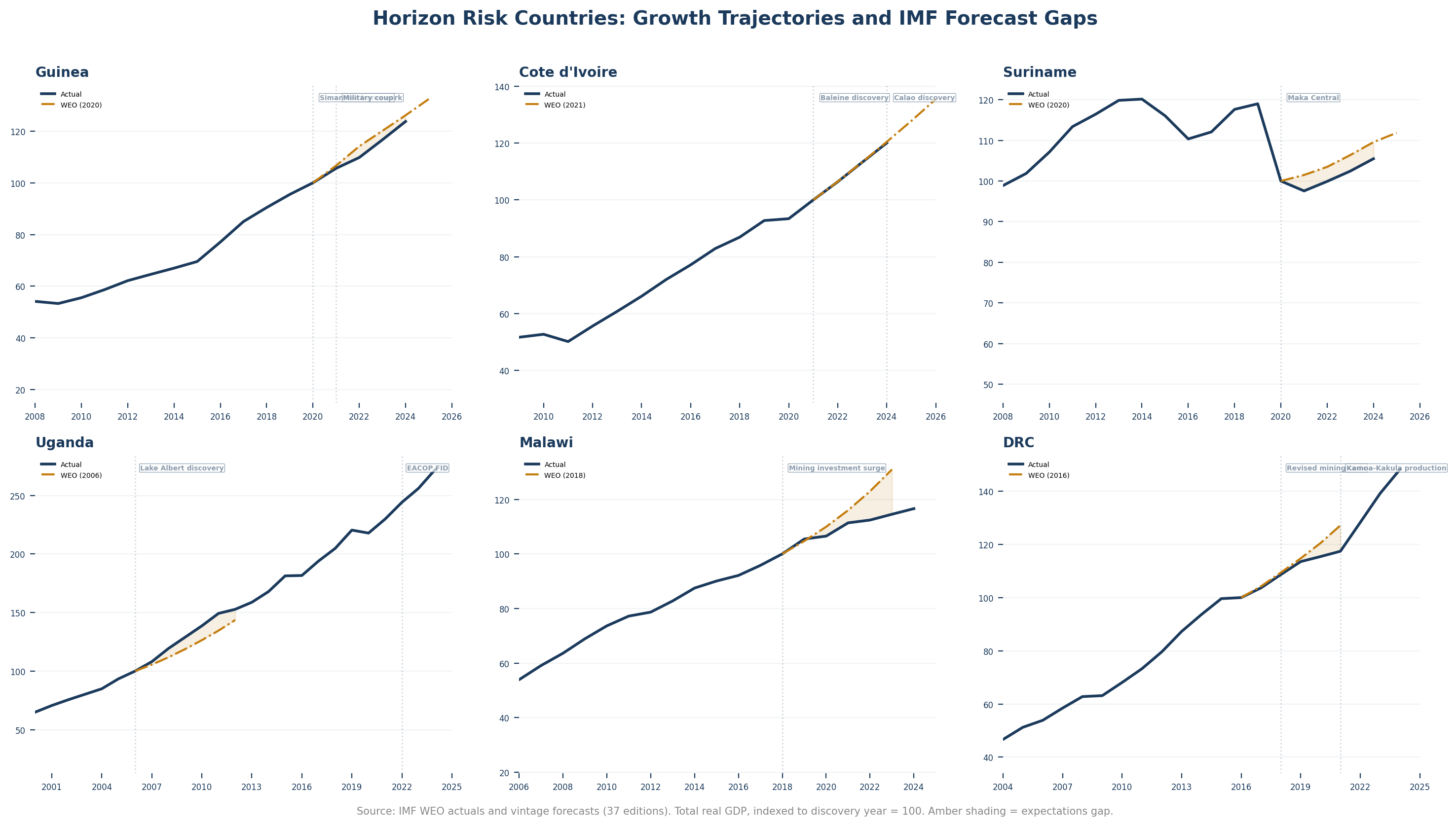
Total real GDP vs. IMF WEO vintage forecasts. Source: IMF WEO.
Core Threats
Seven categoriesThe Presource Curse
Damage begins at discovery — years before the first dollar of revenue arrives.
The distortions that emerge between resource discovery and first production: premature borrowing, fiscal overexpansion, governance deterioration, and expectation shocks. Triggered by anticipated wealth, not extraction itself.
The Resource Curse
Countries rich in resources systematically underperform their resource-poor peers.
Dutch disease, institutional erosion driven by rent-seeking, fiscal volatility from commodity price swings, and conflict fuelled by resource rents.
Over-Borrowing & Debt Traps
Borrowing against futures that never arrive on schedule — or at all.
Hidden debt, commodity-collateralised lending, off-budget liabilities, and the dynamics by which fiscal optimism becomes debt crisis.
Citizen Expectation Shocks
When the gap between what was promised and what arrives becomes explosive.
The political economy of unmet expectations. Resource discoveries or political transitions reset expectations — and when reality lags, the result is instability or populist policy pivots.
Fiscal Rigidity Traps
Structurally committed expenditure — one shock away from crisis.
Subsidies, public sector wage bills, and quasi-fiscal obligations that consume fiscal space before shocks arrive — leaving no room to absorb them.
External Shocks & Contagion
Externally originating threats that tip vulnerable economies into lasting downturns.
Why some countries absorb commodity price collapses, trade disruptions, and pandemic aftershocks — while others experience lasting growth damage.
Growth Mis-Forecasting & Expectations Management
Over-optimistic official projections create the permission structure for fiscal overexpansion.
Systematic bias in official growth and revenue forecasts — by governments, the IMF, and international institutions — that validates premature spending, borrowing, and political promises. When the forecast is wrong, the commitments remain.
Compounding Vulnerabilities
Six categoriesThese vulnerabilities do not always trigger acute crises on their own — but they amplify core threats and narrow the window for effective response. A country in the presource window with weak institutions, high aid dependence, and climate exposure faces a compounded risk that no single-threat framework captures.
Institutional Erosion & Governance Decay
Slow-burn deterioration that steadily degrades the foundations of growth.
Aid & Remittance Dependence
When external support undermines the domestic institutions it is meant to build.
Climate Vulnerability
Climate shocks as a growth threat multiplier for the world's most exposed economies.
Structural Transformation Failure
Premature deindustrialisation and failure to move up the value chain.
Premature Sovereign Wealth Funds
Saving the future while the present burns — SWFs created under wrong preconditions.
Demographic Pressure
Rapid population growth amplifying expectation shocks and spending pressure.