In Brief
Ghana was widely regarded as a model of African development — democratic, growing, and fiscally prudent. The 2007 discovery of the Jubilee oil field was supposed to accelerate that trajectory. Instead, the anticipation of oil revenues triggered a decade of fiscal overexpansion, debt accumulation, and governance strain that culminated in an IMF bailout request in 2014 — three years after oil production had already begun. Unlike other presource cases, Ghana's total GDP growth broadly tracked IMF expectations over the post-discovery decade; the damage was not primarily through growth underperformance, but through a fiscal and debt trajectory that anticipated revenues mortgaged before a single barrel was lifted.
Growth Outcome vs. Counterfactual
The chart below shows actual total GDP (navy) against the IMF WEO rolling 1-year-ahead forecast chain from the discovery year (amber dashed). Both series use IMF WEO data, indexed to the discovery year = 100. Shading highlights the direction of the expectations gap: amber where the forecast exceeds actual, navy where actual exceeds the forecast.
Anatomy of a Lost Decade
Total GDP trajectories for resource-discovering countries — actual outcomes vs. IMF forecasts at time of discovery. Index: discovery year = 100.
Source: IMF World Economic Outlook vintage forecasts (actual growth and 1-year-ahead forecast chains). Amber shading: forecast exceeds actual (over-forecast). Navy shading: actual exceeds forecast. Both series indexed to discovery year = 100. 9 countries covering SSA hydrocarbon and copper discoveries, and Guyana.
Borrowing Against Expectations
The chart below shows how central government debt (% of GDP) responded to the discovery in Ghana, measured in years since discovery and plotted against the non-HIPC peer average. Use the view toggle to switch between debt levels and change from discovery.
Borrowing Against Expectations
How public debt levels respond to giant petroleum discoveries. Central government debt as % of GDP, aligned to discovery year.
Source: IMF Global Debt Database 2.0 (1950–2024). Central government debt except Tanzania (general government). Amber shading indicates the first 5 years post-discovery. * = HIPC debt relief overlaps discovery window (shown dashed). Bold grey line = non-HIPC average.
Debt and the Oil Cycle
Central government debt (navy, left) plotted against Brent crude (amber, right) across Ghana's discovery and production period. Debt rose steadily from discovery through first oil, then accelerated even as Brent fell after 2014 — a fiscal trajectory increasingly detached from the commodity cycle.
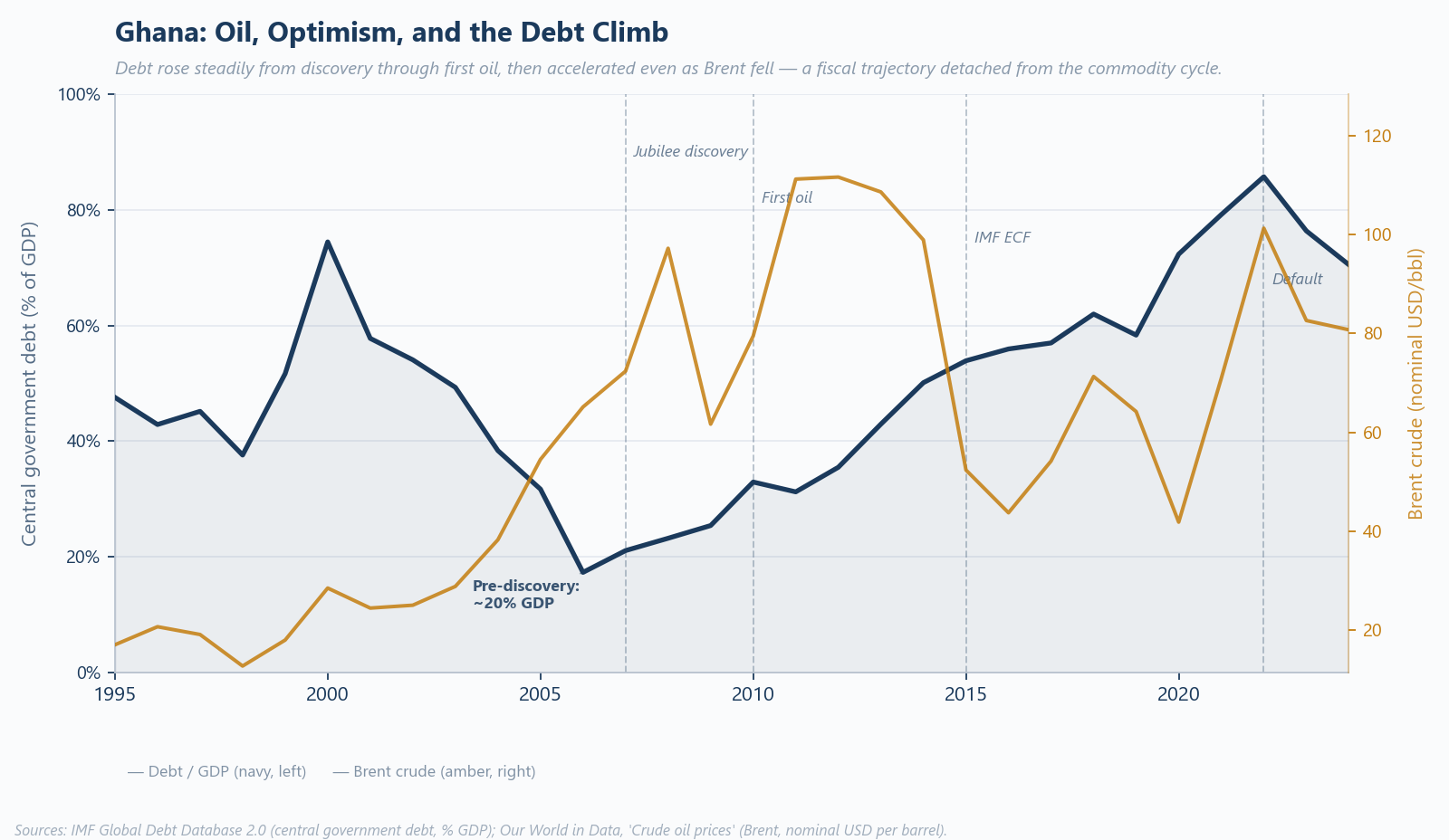
Source: IMF Global Debt Database 2.0; Our World in Data crude oil prices (Brent, nominal USD/bbl).
Lessons and Policy Implications
Expect expectations to move first
The presource curse operates through psychology and politics, not just fiscal accounts. The moment of discovery resets expectations — of citizens, politicians, creditors, and investors — and those expectations shape behaviour immediately, years before revenue arrives.
Fiscal rules alone are insufficient
Ghana passed the Petroleum Revenue Management Act in 2011. But the rules were not followed. Governance quality at the point of discovery determines whether institutional safeguards hold under political pressure.
Election cycles amplify presource dynamics
Ghana's 2008 and 2012 elections fell squarely in the presource and early-production windows. Both cycles saw significant expenditure surges. Democratic accountability, paradoxically, can accelerate presource curse dynamics when citizens expect oil-funded dividends.
Revenue underperformance compounds the problem
Jubilee field output fell well short of initial projections. Fiscal plans built on optimistic forecasts were immediately underfunded. Countries in the presource window should base fiscal plans on conservative — not central — revenue scenarios.
The window for intervention is narrow
By the time Ghana entered the IMF programme in 2014, the debt had accumulated, the exchange rate had collapsed, and the fiscal space had been consumed. Preventive advice delivered in 2008–2010, before spending commitments hardened, could have materially changed the outcome.
References
- Bawumia, M. and Halland, H. (2017). Oil Discovery and Macroeconomic Management: The Recent Ghanaian Experience. WIDER Working Paper 2017/185.
- Cust, J. and Mihalyi, D. (2017). 'The Presource Curse'. Finance & Development, 54(4). IMF.
- Cust, J. and Mihalyi, D. (2017). 'Evidence for a Presource Curse? Oil Discoveries, Elevated Expectations, and Growth Disappointments'. World Bank Policy Research Working Paper 8140. Washington DC: World Bank.
- World Bank (2009). Economy-Wide Impact of Oil Discovery in Ghana. Report No. 47321-GH.
James Cust · Development Economics · jamescust.com