In Brief
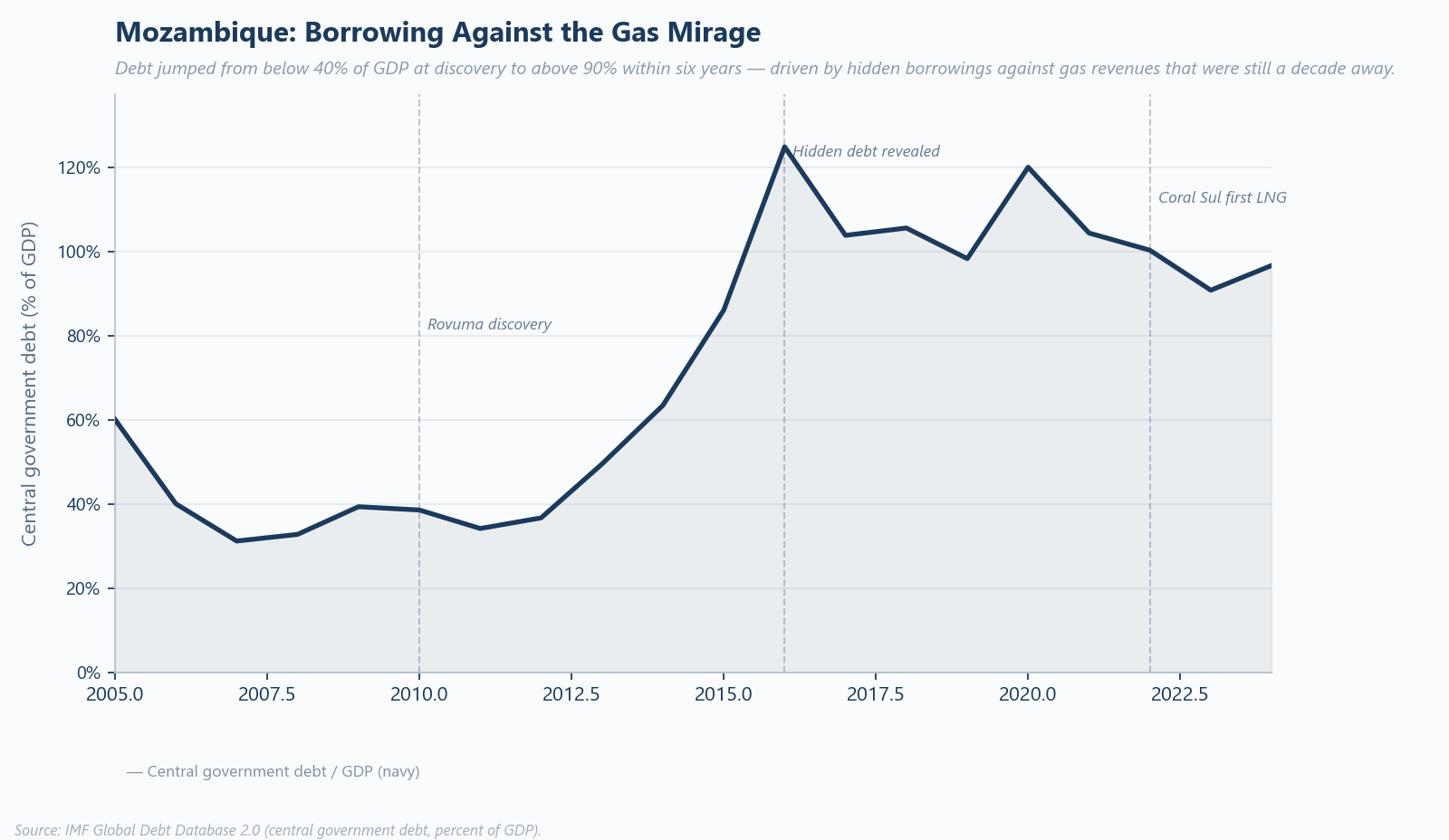
Mozambique spent most of the 1990s and 2000s emerging from civil war to become one of sub-Saharan Africa's fastest-growing economies — celebrated at the IMF's own "Africa Rising" conference in Maputo in 2014. That same year, government officials were secretly guaranteeing $2 billion in off-budget loans to shell companies, using anticipated gas revenues as collateral. When the hidden debt was revealed in 2016 — six years after the Rovuma discoveries and six years before meaningful gas production — the IMF suspended its programme, fourteen budget support donors withdrew, and the metical collapsed.
Growth Outcome vs. Counterfactual
The chart below shows actual total GDP (navy) against the IMF WEO rolling 1-year-ahead forecast chain from the discovery year (amber dashed). Both series use IMF WEO data, indexed to the discovery year = 100. Shading highlights the direction of the expectations gap: amber where the forecast exceeds actual, navy where actual exceeds the forecast.
Anatomy of a Lost Decade
Total GDP trajectories for resource-discovering countries — actual outcomes vs. IMF forecasts at time of discovery. Index: discovery year = 100.
Source: IMF World Economic Outlook vintage forecasts (actual growth and 1-year-ahead forecast chains). Amber shading: forecast exceeds actual (over-forecast). Navy shading: actual exceeds forecast. Both series indexed to discovery year = 100. 9 countries covering SSA hydrocarbon and copper discoveries, and Guyana.
Borrowing Against Expectations
The chart below shows how central government debt (% of GDP) responded to the discovery in Mozambique, measured in years since discovery and plotted against the non-HIPC peer average. Use the view toggle to switch between debt levels and change from discovery.
Borrowing Against Expectations
How public debt levels respond to giant petroleum discoveries. Central government debt as % of GDP, aligned to discovery year.
Source: IMF Global Debt Database 2.0 (1950–2024). Central government debt except Tanzania (general government). Amber shading indicates the first 5 years post-discovery. * = HIPC debt relief overlaps discovery window (shown dashed). Bold grey line = non-HIPC average.
Borrowing Against the Gas Mirage
Central government debt as a share of GDP across Mozambique's discovery and hidden-debt period. Debt jumped from below 40% of GDP at the 2010 Rovuma discovery to above 90% within six years — driven by hidden borrowings against gas revenues that were still a decade away. Coral Sul delivered first LNG in 2022, twelve years after discovery.
Source: IMF Global Debt Database 2.0 (central government debt, percent of GDP).
Lessons and Policy Implications
Hidden debt is a distinct and more dangerous variant
Off-budget borrowing with secret government guarantees removed every corrective mechanism. Transparency requirements for government guarantees and contingent liabilities are as critical as budget deficit rules in the presource window.
Anticipation changes the governance environment, not just fiscal accounts
The Rovuma discoveries transformed Mozambique's political economy before any revenue arrived. Control of anticipated gas rents became the prize — governance deteriorated precisely when it needed to be strongest.
Aid dependence amplifies the presource shock
Around half of Mozambique's budget was funded by external aid. When donors withdrew in 2016, the adjustment was immediate and severe. The same governance failures that trigger the presource curse also trigger donor withdrawal.
Production delays are systematically underestimated
First gas was projected for 2018. Coral Sul achieved first gas in 2022 — four years late. TotalEnergies' Mozambique LNG remains suspended indefinitely. Countries should anchor fiscal frameworks to the longest plausible timeline.
Insurgency and resource governance are connected
The jihadist insurgency in Cabo Delgado did not arise in isolation. Governance failures in the management of LNG concessions created conditions that external actors exploited. The presource curse can generate the instability that prevents the resource from delivering its promise.
References
- Centro de Integridade Publica (2021). The True Cost of Mozambique's Hidden Debts.
- Cust, J. and Mihalyi, D. (2017). 'The Presource Curse'. Finance & Development, 54(4). IMF.
- Cust, J. and Mihalyi, D. (2017). 'Evidence for a Presource Curse? Oil Discoveries, Elevated Expectations, and Growth Disappointments'. World Bank Policy Research Working Paper 8140. Washington DC: World Bank.
- IMF (2016). 'IMF Statement on Mozambique'. Press release, April 2016.
- Ruzzante, M. and Sobrinho, N. (2022). 'The Fiscal Presource Curse'. IMF Working Paper 22/10.
James Cust · Development Economics · jamescust.com